
وبلاگ
The Whispering Hallway: A Psychological Horror Story
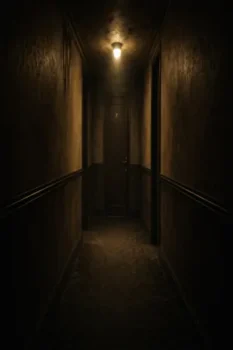
When sleepless nights in an aging apartment building begin to reveal voices no one else can hear, fear
stops feeling imagined.
psychological horror story
instgram
The Whispering Hallway
There were rules in the building that nobody bothered to print.
Do not buzz strangers in after midnight.
Do not let the laundry room door lock behind you.
And if you wake to whispering in the hallway, do not open your apartment door, no matter how familiar the voice sounds.
Mara learned the first two from other tenants. The third, she learned alone.
She had moved into Wren House in late November, when the city was all rain and weak yellow light. The building had once been elegant, or so the cracked marble in the lobby suggested. Now it smelled faintly of wet plaster, old radiator heat, and something sweeter underneath, like flowers left too long in water.
The rent was low for a reason. That should have warned her. Cheap apartments, like cheerful obituaries, usually hide the important detail in the middle.
Still, she took it.
After the divorce, after the humiliating downsizing at work, after the silence of too many evenings spent eating over the sink, Wren House felt less like a mistake and more like a place where mistakes came to retire. She was on the fourth floor, in a narrow one-bedroom at the end of the corridor. Apartment 4F. The last door before the blind turn in the hall.
She liked that at first. Fewer neighbors passing. Fewer chances to make small talk with exhausted strangers. Fewer reminders that the rest of the world still moved in pairs and groups while she had become, somehow, a single loose thread.
The first week was quiet enough.
Then, on a Tuesday night, Mara woke to the sound of someone speaking just outside her door.
H2: The Hallway Whispers at Night
At first she thought it was the television from another unit, muffled through the wall. But the sound was too close, too intimate. Not a show. Not conversation. Whispering.
A woman’s voice, low and patient, as if explaining something to a child.
Mara sat up in bed and held her breath.
The whisper continued. Not words exactly. More like the shape of words, forming and falling apart before she could catch them. She checked the glowing digits of her alarm clock. 2:13 a.m.
Then came a second voice.
A man this time, softer still, overlapping the first.
She got out of bed and padded toward the door, every board in the floor groaning like a warning. The peephole showed only the stretch of dim hallway under the buzzing ceiling light. Brown runner carpet. Faded wallpaper. The framed print of an orchard hung crooked across the hall.
No one there.
The whispering stopped the moment her eye touched the glass.
In the morning, she mentioned it to the super, a broad-shouldered man named Anton who always looked as though he’d just been interrupted in the middle of a bad thought.
“Old pipes,” he said.
“Pipes sound like voices?”
“In this building, they can sound like anything.”
He said it without smiling.
That evening, Mrs. Holloway from 4B caught Mara by the mailboxes. She was a tiny woman with perfect lipstick and the nervous gaze of someone listening to a second conversation behind yours.
“You’re in 4F,” she said.
Mara nodded.
Mrs. Holloway hesitated. “Has anyone knocked?”
“No.”
“Good.”
She pressed her lips together, as though she’d already said too much, and shuffled away before Mara could ask what she meant.
That should have been enough. A reasonable person would have ignored it, bought earplugs, and blamed the building. Humans adore lies that let them sleep.
Mara was not sleeping much anymore.
By Friday, the whispering came every night.
Always between 2:00 and 2:20. Always directly outside her door.
Sometimes it sounded like a conversation. Sometimes like someone slowly reading from a book. Once, unmistakably, she heard laughter. Not loud laughter. Not happy laughter. The kind people make when they already know how something ends.
She began staying awake for it.
Sitting in the dark on the edge of her bed, listening.
Waiting.
H2: The Apartment Door That Should Stay Closed
On the seventh night, the whispers formed words.
“Mara.”
It was so clear that she stood before she knew she was moving.
“Mara, open the door.”
Her scalp tightened. She took one step toward the entryway, then another, cold spreading through her chest.
The voice was her mother’s.
Not her mother as she sounded now, alive and living three states away. This was the older version of her mother that lived in memory. The one from childhood. The one who used to stand in Mara’s doorway after nightmares and tell her the house only sounded alive because it was settling.
“Mara,” the voice said again, gentle and tired. “Please.”
Her hand reached the lock.
Then she noticed something small and absurd that saved her.
No footsteps.
No shifting of weight. No rustle of clothing. The voice was there, impossible and near, but attached to nothing living.
She backed away from the door so quickly her heel caught the rug and sent her into the wall. The whispering changed at once. The softness dropped away.
The voices multiplied.
Not louder. Worse. Many voices speaking at once, layered and urgent, like a crowd murmuring in a church just before panic.
Her mother’s voice was somewhere inside them. So was her ex-husband’s. Her sister’s. Her own.
Open the door.
Let us in.
You know us.
It’s cold out here.
Mara fled to the bathroom and locked herself inside with the light on, knees pulled to her chest beside the tub. The whispering continued for nearly an hour.
The next morning, her front door bore no marks. No footprints in the dust. No sign anyone had been there.
But something had changed.
At the bottom of the door, just above the threshold, the paint was beginning to bubble outward from the wood. As if moisture had gotten inside. Or fingers were pressing from the other side.
H3: The Tenant in 4F Before Mara
Mara cornered Mrs. Holloway that afternoon in the stairwell.
“Tell me what happened in my apartment.”
The older woman looked stricken, then old in a way Mara had not noticed before.
“It wasn’t your apartment,” she said. “Not really. It was the hall.”
“That means nothing.”
“It means it isn’t tied to walls. It’s tied to that stretch outside your door.”
Mrs. Holloway gripped the railing until her knuckles blanched.
“There was a woman in 4F before you. Lena. Kept to herself. Pleasant enough. Then she started hearing people outside at night. Thought children were playing in the corridor. Thought neighbors were arguing. Then she said the voices knew things. Things they shouldn’t.”
Mara felt the stairwell narrow around her.
“What happened to her?”
Mrs. Holloway looked up the stairs, as if expecting to see someone listening from above.
“One night Anton found her apartment open.”
“Open?”
“She never left. That’s the worst part.”
Mara stared.
Mrs. Holloway swallowed. “Everything was still there. Purse, coat, groceries on the counter. Radio playing. Door open. And the hallway empty.”
That evening Mara packed a bag.
Not much. Laptop. Charger. Two sweaters. Toothbrush. Enough to sleep at a hotel and decide, in daylight and with coffee, whether sane adults could believe in haunted hallways.
She was zipping the bag when the first knock came.
Three soft taps.
Not midnight yet. Not even eleven.
She froze.
Three more taps.
Then Anton’s voice through the door. “Mara? You in there?”
Relief hit hard enough to make her dizzy. She crossed the room, but stopped with her hand hovering over the lock.
“Anton?”
“Need to check your radiator.”
She said nothing.
A pause.
Then, in the same voice and same flat accent, “Open up.”
Mara stepped backward.
Because Anton had never once called it a radiator. He always called it “the heat.” It was a tiny detail, pathetic really, but fear often hinges on grammar.
The knock came again. Harder.
“Mara.”
Now the voice was wrong. Not Anton anymore. Not anyone exactly. It sounded like several people trying to agree on how a human being should sound.
The doorknob began to turn.
Slowly.
Patiently.
From the hallway side.
H2: The Last Door in the Haunted Corridor
Mara grabbed the bag and ran to the bedroom window. Four floors up. Fire escape just beyond the sash. Rain striping the glass.
Behind her, the whispering rose. Not from outside now, but from every crack in the apartment. From the vents. From under the sink. From the narrow seam where wall met ceiling.
She shoved the window open and a gust of November cold slapped the room.
The front door opened behind her with a quiet, delicate click.
She did not turn around.
One leg over the sill. Then the other. She landed hard on the iron platform and nearly slipped, fingers clawing the rail. The rain had made everything slick and black.
Inside the apartment, no footsteps approached.
Only whispering.
Dozens of voices, all close together, all speaking to her back.
“Mara,” they said. “You left the door open.”
She descended too fast, metal stairs screaming beneath her. Second floor. First. Alley. She hit the pavement running, lungs burning, bag thudding against her hip.
She never went back.
Anton called twice the next day, asking where she’d gone and whether she planned to pick up the rest of her things. She blocked the number. Mrs. Holloway left a voicemail that contained only breathing and, at the end, a single sentence:
“It doesn’t like being abandoned.”
That was three months ago.
Mara rents a furnished studio now across town, on a loud avenue where buses hiss all night and strangers argue beneath her window. She sleeps better with noise. Noise belongs to the living.
She tells herself she escaped before anything truly happened.
Then, last night, while brushing her teeth, she noticed the paint above her new apartment door had begun to blister.
Just a little.
As though damp had crept in.
Or someone had placed a patient hand on the other side and started to push.